Beneath the Skin by Ned Beauman
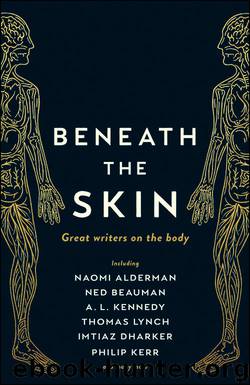
Author:Ned Beauman
Language: eng
Format: epub
Publisher: Profile
Published: 2018-09-16T16:00:00+00:00
KIDNEY
ANNIE FREUD
Apart from having once dissected a rat, a handful of literary references and a hazy childhood memory of a woman throwing a hairbrush at my father from her kidney-shaped dressing table, I hadn’t given much thought to the reality of the kidney. So, my first action was to go to the butchers and buy some lamb’s kidneys.
Once I’d got home, I was surprised not only by their softness but also by their slackness – the way that they behaved almost like a liquid mass, only just held together by their gossamer-fine membrane. How could something of such extraordinary complexity be so flabby? With almost no surface tension, only the very sharpest of blades would cut their flesh. I was also surprised by the apparent homogeneity of their interior substance.
And so, after a tasty steak-and-kidney pie with green peas and boiled potatoes, I arranged my two remaining kidneys on a plate in what I hoped was the kind of still life which invites the viewer to appreciate the anatomical facts and the aesthetic qualities of dead flesh – one kidney displayed whole, the other sliced into two halves. And then I started to paint.
I found myself using the richest maroon, the most delicate pink and the deepest crimson. I wondered what the purpose of my painting was. Finding no answer, I thought about the paintings of Chaim Soutine and Francis Bacon, the anatomical drawings of Da Vinci and Michelangelo and the meanings that have become attached to the depiction of butchered meat in art. I recalled seeing the kidney’s fluent lines in the work of modernist architects and designers. Ernst Freud, the architect and my German Jewish grandfather, liked to include kidney-shaped fishponds in his garden designs. Although I still felt devoid of knowledge, I had handled them, sliced them, seasoned them, cooked them, eaten, stared at and painted them.
I spoke to several distinguished kidney specialists to find out more. I could not help noticing the admiration, passion even, with which they spoke of these organs, praising their diligence, complexity and versatility, using such expressions as ‘fine tuning’ and ‘precise tailoring’, and plying me with such wow-factor statistics as ‘25 per cent of the blood pumped by every heartbeat goes to the kidneys’ and ‘the whole 3 litres of our blood plasma is filtered by the kidneys forty-three times every twenty-four hours’.
My neighbour and friend Marcus Soldini, a GP with some twenty-five years practise behind him, asked me to imagine each kidney as comprising two distinct ‘trees’ – one the blood supply, the other the drainage system – whose outermost twigs are very densely interwoven. ‘Visualise the blood,’ he said, ‘entering the arterial trunk, which divides and subdivides into ever smaller branches, each ending in a tiny knot of capillaries known as the glomerulus, of which there are about one million per kidney.’ He gestured with his hands to show me how each glomerulus is embraced by the outermost twigs of the drainage system, forming a cup-shaped structure known as the Bowman’s capsule, into which it fits snugly, like an acorn in an acorn cup.
Download
This site does not store any files on its server. We only index and link to content provided by other sites. Please contact the content providers to delete copyright contents if any and email us, we'll remove relevant links or contents immediately.
Men In Love by Nancy Friday(5232)
Everything Happens for a Reason by Kate Bowler(4733)
The Immortal Life of Henrietta Lacks by Rebecca Skloot(4574)
Why We Sleep by Matthew Walker(4434)
The Sports Rules Book by Human Kinetics(4379)
Not a Diet Book by James Smith(3410)
The Emperor of All Maladies: A Biography of Cancer by Siddhartha Mukherjee(3146)
Sapiens and Homo Deus by Yuval Noah Harari(3064)
Day by Elie Wiesel(2779)
Angels in America by Tony Kushner(2652)
A Burst of Light by Audre Lorde(2597)
Endless Forms Most Beautiful by Sean B. Carroll(2473)
Hashimoto's Protocol by Izabella Wentz PharmD(2371)
Dirty Genes by Ben Lynch(2313)
Reservoir 13 by Jon McGregor(2300)
Wonder by R J Palacio(2203)
And the Band Played On by Randy Shilts(2197)
The Immune System Recovery Plan by Susan Blum(2057)
Stretching to Stay Young by Jessica Matthews(2036)
